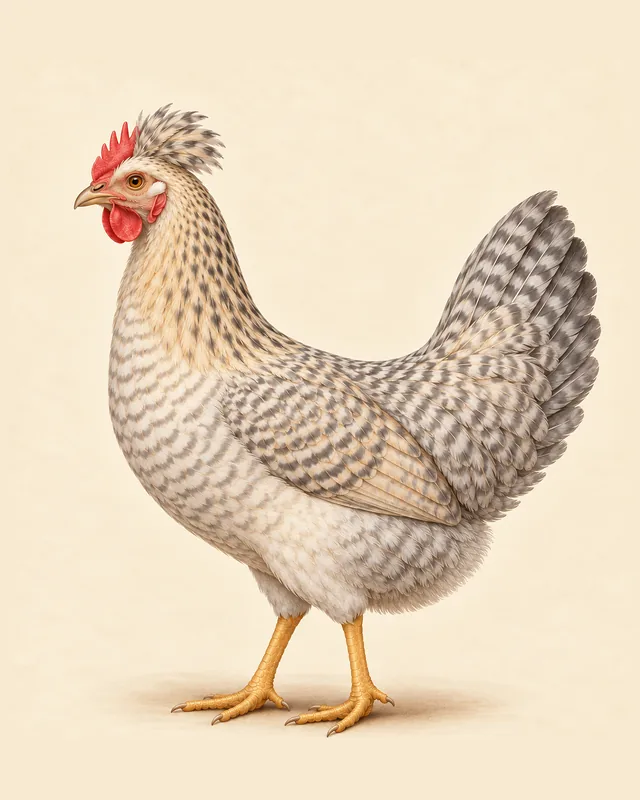
Cream Legbar at a glance
| Egg production | Egg-production range not sufficiently sourced |
|---|---|
| Egg color | blue, blue-green |
| Size | medium; hen weight 5.5 lb |
| Temperament summary | Friendly; good forager |
| Housing class | laying hen |
Would Cream Legbar suit your flock?
Check your climate, coop space, and egg goals against the breed data. We’ll compare the options instead of automatically favoring this bird.
Check my flock fit →Free, eight-question planner · Breed inclusion is not guaranteed.
What color eggs do Cream Legbars lay?
The current breed record lists blue, blue-green eggs. The Cream Legbar Club's overview describes a blue-egg-laying crested bird, with the egg shade varying among lines. The breed is an option to compare alongside Araucana and Ameraucana for a colorful egg basket.
How many eggs do Cream Legbars lay per year?
Egg-production range not sufficiently sourced. Although the breed club describes Legbars as productive layers, our current structured database does not have a sufficiently supported numerical annual egg range for this breed. We therefore do not publish a precise estimate or assume that all lines lay the same number of eggs. If egg volume is a major priority, compare breeds with documented ranges in the egg-laying guide.
What does autosexing mean for Cream Legbar chicks?
Autosexing means characteristic hatch-down patterns can help distinguish male and female chicks within established lines. The breed club describes these down-pattern differences for Legbars, alongside the breed's distinctive crest. Hatchery claims still deserve verification with the breeder; autosexing does not make it appropriate to assume every individual chick is sexed without error. See the Cream Legbar Club's phenotype description.
Are Cream Legbars good free-range chickens?
The breed-club information behind our record describes good forager and an ability to adapt to yards and runs. The record also includes predator-awareness evidence, but it comes from a breed club and is not a substitute for safe fencing, secure nighttime housing, and vigilance. Read the free-ranging comparison for additional management tradeoffs. Our dataset does not yet support a separate numerical cold- or heat-tolerance assessment for Cream Legbars.
Compare blue eggs and foraging traits with your egg goals, coop/run capacity, climate, and household preferences before settling on a mix.
Compare breeds in my flock plan →Strongest documented traits
Egg-color uniqueness
Very distinctive egg color
blue/blue-green eggs
Source confidence: High
Foraging
Good forager
good foragers
Source confidence: High
Temperament
Calm temperament
breed club describes friendly
Source confidence: Medium
Predator awareness
Good predator awareness
does well avoiding predators free range
Source confidence: Medium
Confinement tolerance
Does well in confinement
can adapt to small yards and runs
Source confidence: Medium
How the planner uses this breed
The flock planner does not rank Cream Legbar from a single overall score stored in the database. Instead, it weights individual traits differently for each household. Cold hardiness matters more in harsh winters; heat tolerance matters more in hot climates; docility receives additional weight when children will handle the birds; and housing size can prevent a breed mix from being recommended even when its preference score is strong.
Sources used for this record
Last database review: 2026-10-03. Trait values are normalized to a 1–5 planning scale; see the methodology for how uncertainty is handled.