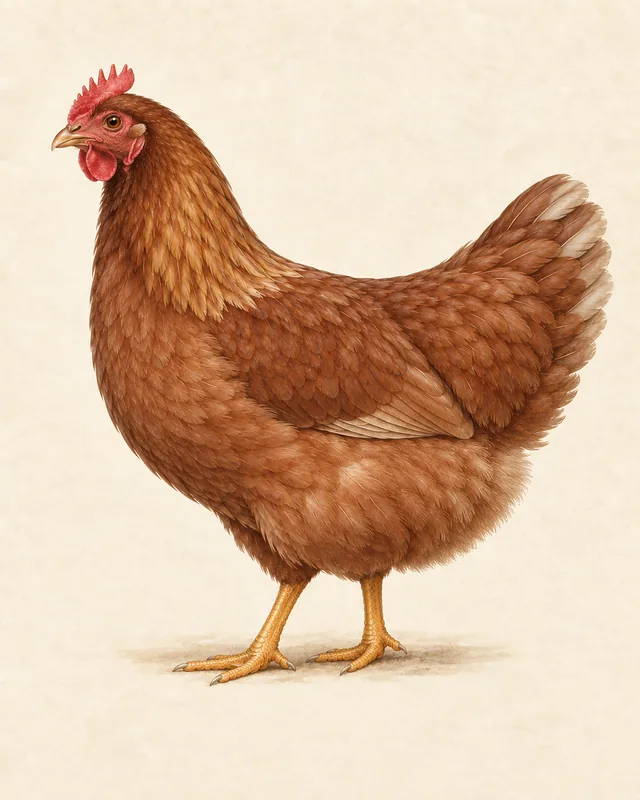
ISA Brown at a glance
| Egg production | 300–320 eggs/year |
|---|---|
| Egg color | light brown |
| Size | medium |
| Temperament summary | Calm, docile |
| Housing class | laying hen |
Would ISA Brown suit your flock?
Check your climate, coop space, and egg goals against the breed data. We’ll compare the options instead of automatically favoring this bird.
Check my flock fit →Free, eight-question planner · Breed inclusion is not guaranteed.
How many eggs do ISA Brown chickens lay?
Our source-backed breed record lists 300–320 eggs/year, usually with light brown shells. Utah State University Extension describes ISA Browns as high-producing, calm laying hybrids. This is an annual planning estimate under favorable management, not a guarantee for each bird or each year. Age, daylight, feed, and health influence the actual egg count.
Are ISA Browns good chickens for beginners?
The current dataset rates ISA Browns highly for docility and beginner friendliness, based on Utah State University Extension. They are a sensible candidate for households prioritizing approachable brown-egg layers. A friendly reputation does not replace humane handling, adequate space, and daily care; individual hens differ.
Is an ISA Brown a breed or a hybrid?
An ISA Brown is a commercially developed laying hybrid, not a traditional standardized, true-breeding chicken breed. Breeding two ISA Browns at home does not reliably reproduce the same commercial cross or its uniform laying performance. For a deliberate home breeding project, compare established breeds and seek breeding-specific guidance rather than assuming hybrid offspring match their parents.
ISA Brown vs. Red Sex Link: what's the difference?
Red Sex Link is a broader term for certain crossbred chickens whose chick feather or down color helps identify sex at hatch. ISA Brown identifies a particular commercial laying hybrid. They overlap in being productive brown-egg layers, but the names do not establish identical parentage or performance. The current data do not supply breed-specific climate or foraging ratings for ISA Brown, so those attributes remain unknown—not average.
Compare egg-laying breeds and hybrids
These numbers describe the current source registry's annual planning estimates; they do not predict the output of a particular hen. A missing value is not zero or average. Hybrid labels are not interchangeable with standardized breeds.
| Chicken | Egg color | Estimated annual eggs | Planner status |
|---|---|---|---|
| ISA Brown | light brown | 300–320 eggs/year | Eligible for planner recommendations |
| Red Sex Link | brown | 290–320 eggs/year | Eligible for planner recommendations |
| California White | white | Egg-production range not sufficiently sourced | Reference record only |
| White Leghorn | white | 280–320 eggs/year | Eligible for planner recommendations |
For additional tradeoffs, see our egg-laying chicken guide and coop-size calculator.
Balance your preferred egg color and production against climate, space, temperament, and flock size.
Compare laying hens in the free flock planner →Strongest documented traits
Egg production
Exceptional egg production
300-320 eggs/year
Source confidence: High
Temperament
Very calm and easy to handle
calm, docile
Source confidence: High
Beginner friendliness
Excellent for first-time keepers
explicitly recommended for beginners
Source confidence: High
Things to consider
These are traits that may be a drawback depending on what you want from your flock. Individual birds can vary.
Dual-purpose value
Primarily a specialty bird
selected primarily for egg production
Source confidence: Medium
How the planner uses this breed
The flock planner does not rank ISA Brown from a single overall score stored in the database. Instead, it weights individual traits differently for each household. Cold hardiness matters more in harsh winters; heat tolerance matters more in hot climates; docility receives additional weight when children will handle the birds; and housing size can prevent a breed mix from being recommended even when its preference score is strong.
Sources used for this record
Last database review: 2026-10-03. Trait values are normalized to a 1–5 planning scale; see the methodology for how uncertainty is handled.