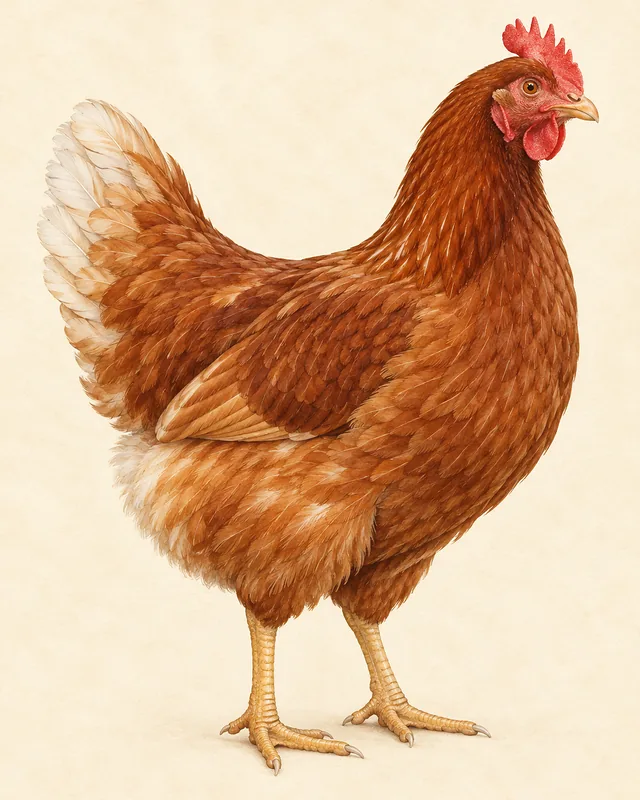
Red Sex Link at a glance
| Egg production | 290–320 eggs/year |
|---|---|
| Egg color | brown |
| Size | medium |
| Temperament summary | Calm |
| Housing class | laying hen |
Would Red Sex Link suit your flock?
Check your climate, coop space, and egg goals against the breed data. We’ll compare the options instead of automatically favoring this bird.
Check my flock fit →Free, eight-question planner · Breed inclusion is not guaranteed.
What is a Red Sex Link chicken?
Red Sex Link describes a crossbred laying chicken type rather than one standardized breed. Certain parent-line combinations allow day-old chicks to be distinguished by their sex-linked coloration. Parentage can vary among hatcheries and names such as Red Star, Golden Comet, or Cinnamon Queen describe particular crosses rather than every red sex-link. Poultry Extension explains the genetics and examples.
How many eggs do Red Sex Link hens lay?
Our current record lists 290–320 eggs/year, with brown eggs. Mississippi State University Extension reports that sex-linked laying crosses can often produce 300 eggs annually or more. Our planning range is an estimate covering a broad type, not a performance promise for every named hatchery line or every year.
Are Red Sex Links calm and suitable for free-ranging?
The source-backed dataset lists a calm temperament, but rates their documented foraging ability as poor. A calm, productive hen can still benefit from supervised outdoor access, yet it should not be selected solely for independent foraging. Maintain complete feed, predator protection, and secure housing. Learn more in the free-ranging guide.
Can Red Sex Link chickens breed true?
No reliable expectation of repeating the original sex-linked color pattern or uniform commercial performance should be made from mating Red Sex Link offspring to each other. Poultry Extension explains that sex-linked crosses cannot simply be reused to create the same cross in the next generation. Compare ISA Brown for another brown-egg hybrid, or Rhode Island Red if breeding a traditional breed matters more.
Compare egg-laying breeds and hybrids
These numbers describe the current source registry's annual planning estimates; they do not predict the output of a particular hen. A missing value is not zero or average. Hybrid labels are not interchangeable with standardized breeds.
| Chicken | Egg color | Estimated annual eggs | Planner status |
|---|---|---|---|
| ISA Brown | light brown | 300–320 eggs/year | Eligible for planner recommendations |
| Red Sex Link | brown | 290–320 eggs/year | Eligible for planner recommendations |
| California White | white | Egg-production range not sufficiently sourced | Reference record only |
| White Leghorn | white | 280–320 eggs/year | Eligible for planner recommendations |
For additional tradeoffs, see our egg-laying chicken guide and coop-size calculator.
Balance your preferred egg color and production against climate, space, temperament, and flock size.
Compare laying hens in the free flock planner →Strongest documented traits
Egg production
Exceptional egg production
often 300+ eggs/year
Source confidence: High
Temperament
Very calm and easy to handle
sex-link listed calm
Source confidence: High
Things to consider
These are traits that may be a drawback depending on what you want from your flock. Individual birds can vary.
Broodiness
Rarely broody
Source confidence: High
Foraging
Poor forager
Source confidence: High
How the planner uses this breed
The flock planner does not rank Red Sex Link from a single overall score stored in the database. Instead, it weights individual traits differently for each household. Cold hardiness matters more in harsh winters; heat tolerance matters more in hot climates; docility receives additional weight when children will handle the birds; and housing size can prevent a breed mix from being recommended even when its preference score is strong.
Sources used for this record
- Mississippi State University Extension: Choosing the Right Breed for Your Backyard Flock
- Mississippi State University Extension: Poultry Beginnings: Raise Your Own Backyard Chickens
- eXtension / USDA-NIFA supported resource: Sex-Linked Traits in Poultry
Last database review: 2026-10-03. Trait values are normalized to a 1–5 planning scale; see the methodology for how uncertainty is handled.